The world’s leading genocide scholars have broken the silence — led by an Israeli-born historian who resisted the conclusion until he couldn’t. A guide to the one book to hand a skeptic.
Prepared July 2026•~10 min read•For pastors, skeptics & everyone in between
“There’s so much propaganda out there — it’s hard to know what’s true.”
If you’ve raised Gaza in a church hallway, you’ve heard some version of that sentence. And the person saying it isn’t wrong to be careful: the information war is real, social feeds reward outrage over accuracy, and a serious Christian should want better evidence than a viral clip.
Farrar, Straus and Giroux, 2026
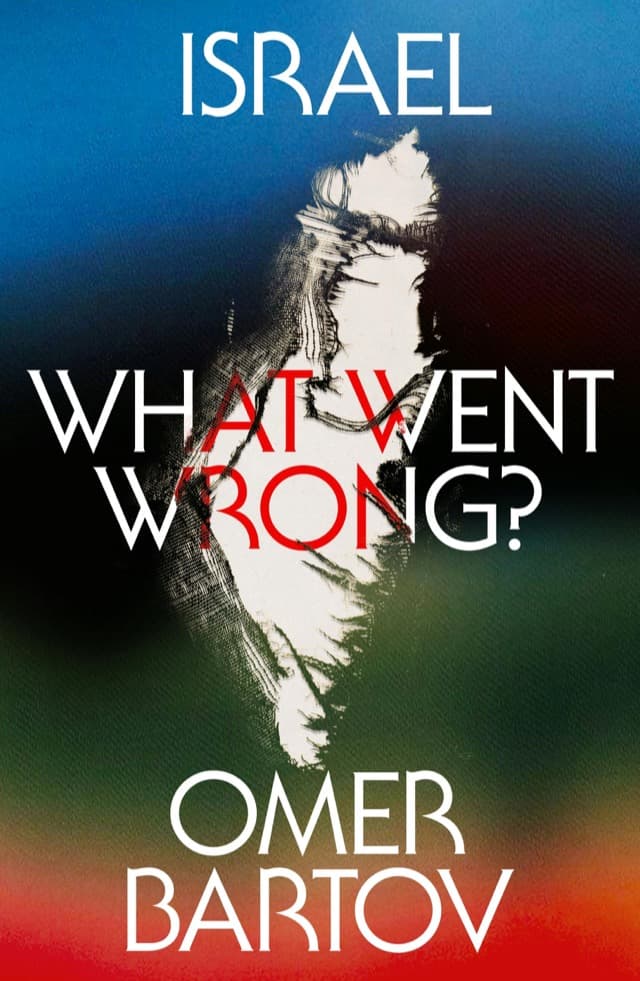
So take the feeds off the table entirely. This page is about a book — written not by an activist or an influencer, but by a scholar at the very top of the field, published by Farrar, Straus and Giroux, and shortlisted for the 2026 Orwell Prize for Political Writing.[5, 6] If the objection is “I can’t trust the noise,” this is the signal: Omer Bartov’s Israel: What Went Wrong?[1]
Who Omer Bartov is
Bartov is the Dean’s Professor of Holocaust and Genocide Studies at Brown University[15] — a scholar the U.S. Holocaust Memorial Museum has described as one of the world’s leading specialists on the subject of genocide.[12] He was born on a kibbutz, grew up in Tel Aviv, and, in his own words, “served in the Israel Defense Forces (IDF) for four years, a term that included the 1973 Yom Kippur War and postings in the West Bank, northern Sinai and Gaza, ending my service as an infantry company commander.”[1, 9] He then made his career as a historian of the German army and the Holocaust — the field’s hardest ground.[1, 8]
In other words: this is not TikTok. This is the academic leadership of the discipline that exists to recognize the crime — speaking about the country where he was born, served, and buried his dead.
The reluctant witness
Here is the part that answers the propaganda objection better than any fact-check: Bartov said no first. One month into the war, with others already using the word, he publicly refused it.
“As a historian of genocide, I believe that there is no proof that genocide is currently taking place in Gaza, although it is very likely that war crimes, and even crimes against humanity, are happening.”
Omer Bartov — The New York Times, November 10, 2023[7, 8]
What he offered instead was a warning — that the openly declared intentions of Israeli leaders could “easily tip into genocidal action” — because, as he explained days later, “when you study genocide, you always look back and say, ‘There were all these signs that it’s going to happen, and why was nobody doing anything about it…?’ … Instead of waiting until something happens, it’s better to warn.”[7, 8] Then he watched the evidence. In May 2024 the IDF moved on Rafah — the last refuge, where roughly a million displaced people had been told to go for their own safety.[11] That August, he wrote the sentence his whole career had trained him never to write lightly:
“I no longer believe that. By the time I travelled to Israel, I had become convinced that at least since the attack by the IDF on Rafah on 6 May 2024, it was no longer possible to deny that Israel was engaged in systematic war crimes, crimes against humanity and genocidal actions.”
“This was a painful conclusion to reach, and one that I resisted as long as I could. But I have been teaching classes on genocide for a quarter of a century. I can recognize one when I see one.”
Omer Bartov — The New York Times, July 15, 2025[10, 35]
The cost was personal, and he has never hidden it: “I was born and raised in Israel. I spent the first half of my life in Israel. I served in the Israeli military. And for me, to see what is happening is personally, not only just as a mere human being, but also as an Israeli, heartbreaking.”[12] That trajectory — refusal, evidence, conclusion — is what scholarly integrity looks like. It is the opposite of propaganda.
What the book argues
Israel: What Went Wrong? (Farrar, Straus and Giroux, April 2026)[3, 5, 13] grew out of that journey. Its opening pages lay the case out plainly — and pose the question the whole book answers:
“How is it possible that a state founded in the immediate aftermath of the Holocaust stands today credibly accused of perpetrating large-scale war crimes, forcible displacement of civilian populations, and crimes against humanity? By what bitter cunning of history have we come to the point that not even eight decades after the Jewish state was established in 1948 — the same year in which the Genocide Convention was adopted by the United Nations in direct response to the Nazi extermination of European Jewry — Israel engages for two years in a genocidal undertaking with almost total impunity from the very international legal regime set up after World War II to prevent and punish this crime?”
Israel: What Went Wrong? — from the book’s introduction, “From Liberation to Oppression”[2]
From there the book traces, in the publisher’s words, “the transformation of Zionism from a movement of Jewish emancipation and liberation into a state ideology of ethno-nationalism, exclusion and violent domination of Palestinians.”[1] Bartov’s method is the discipline’s: “in order to identify genocide, you have to do two things. You have to see that intent has been shown and that intent is being implemented” — and to the most common objection he answers directly: “The bar is not the Holocaust.”[14] It is also a personal book, dedicated to his father, “the last Zionist,” and drawing on his own service — including the moment, patrolling occupied streets as a young soldier, when “for the first time, I understood what it meant to occupy another people.”[2]
Don’t take our word for its quality. The Guardian’s reviewer — Avi Shlaim, emeritus professor at the University of Oxford — called it “perceptive, sophisticated, erudite, elegantly written and strikingly fair-minded,” a book “written more in sorrow than in anger” whose “goal is not to condemn Zionism but to explain its evolution from a dream to a nightmare.”[4] Publishers Weekly: “a clear-eyed work of moral reckoning.”[5] The New York Times’ reviewer noted that “Bartov doesn’t go in for rhetorical extravagance; his writing style is clear, sober and deliberate.”[3] Critics’ aggregate verdict: rave.[3]
He is not alone
Bartov’s conclusion sits inside a body of findings from the institutions whose entire purpose is answering this question — each stated here in its own exact terms:
The International Association of Genocide Scholars — described by NPR as the world’s leading association of scholars who study genocide — resolved on August 31, 2025 that “Israel’s policies and actions in Gaza meet the legal definition of genocide” under the 1948 Convention, with 86% of members who voted in favor.[16, 17, 18]
A UN commission of inquiry chaired by Navi Pillay concluded in September 2025 that “Israel has committed genocide against Palestinians in the Gaza Strip” — finding four of the Convention’s five genocidal acts, with intent established under the International Court of Justice’s own standard.[25] A UN Special Committee had found Israel’s methods of warfare “consistent with the characteristics of genocide” ten months earlier.[24]
Amnesty International “found sufficient basis to conclude that Israel has committed and is continuing to commit genocide against Palestinians in the occupied Gaza Strip” (December 2024); Human Rights Watch found Israel responsible for “acts of genocide” and the crime against humanity of extermination.[20, 21]
Israel’s own human-rights community: in July 2025, B’Tselem and Physicians for Human Rights–Israel became the first two Israeli organizations to say it — B’Tselem’s “unequivocal conclusion that Israel is taking coordinated action to intentionally destroy Palestinian society in the Gaza Strip… In other words: Israel is committing genocide against Palestinians in the Gaza Strip.” Its director: “Nothing prepares you for the realization that you are part of a society committing genocide.”[22, 23, 36]
The International Court of Justice — as early as January 2024 — ordered Israel, by votes of 15–2 and 16–1, to “take all measures within its power” to prevent all acts within the Genocide Convention’s scope, to punish incitement to genocide, to enable humanitarian assistance, and to preserve evidence.[26] The court has not yet ruled on the merits — what it ordered is that the world’s highest court took the case seriously enough to put Israel under binding preventive orders while it decides.[26, 27]
The Lemkin Institute for Genocide Prevention — named for the man who coined the word — reached its conclusion earliest of all, in December 2023.[19]
And within Bartov’s own guild, he names the peers who — “like me,” he says, after long caution — reached the same conclusion: Shmuel Lederman, William Schabas, Melanie O’Brien, Martin Shaw, A. Dirk Moses, Uğur Ümit Üngör.[10, 12]
ICJ judges ordering Israel to take all measures within its power to prevent acts within the Convention’s scope.
The law, and the obligation
The word itself was born from the Holocaust. Raphael Lemkin — a Polish-Jewish jurist who coined “genocide” in 1944 and learned at Nuremberg that 49 members of his family, including his parents, had been murdered — spent the rest of his life campaigning for a law against the destruction of peoples, and died in 1959, in the U.S. Holocaust Memorial Museum’s words, “impoverished and exhausted by his efforts.”[28] What he won is the Convention on the Prevention and Punishment of the Crime of Genocide — the first human rights treaty the UN General Assembly ever adopted, on December 9, 1948, the day before the Universal Declaration of Human Rights.[29, 30]
Its first article is one sentence: the contracting parties “undertake to prevent and to punish” genocide.[29]Prevent — and the world court has said exactly when that duty begins: “at the instant that the State learns of, or should normally have learned of, the existence of a serious risk that genocide will be committed.”[31] Not after a verdict. Not after the fact. The UN’s own genocide-prevention office is explicit that its early-warning mandate exists so the world can act “in a timely fashion” — without waiting for a formal determination.[33] Signing the legislation that let the United States at last ratify the Convention in 1988, President Reagan put the point plainly: “to make sure that we’re not condemned to relive its crimes.”[32]
The church carries its own version of that vow. In 1948 — the very year of the Convention — the World Council of Churches gathered in Amsterdam and confessed: “We must acknowledge in all humility that too often we have failed to manifest Christian love towards our Jewish neighbours…”[34] “Never again” is not only a treaty. For Christians, it is a repentance we already made once — and the warning signs the world built that whole architecture to catch are the ones now documented, by the field’s leading scholar and the institutions around him, in Gaza.
The answer, in one paragraph
When someone says “we don’t have the evidence — there’s too much propaganda to know what’s true,” hand them this book. Its author is an Israeli-born veteran of the IDF and one of the world’s most credentialed genocide scholars, a man who publicly refused the word in 2023 and spent months testing the evidence before concluding he could no longer responsibly withhold it. Around him stand the leading association of genocide scholars, a UN commission of inquiry, Amnesty International, Human Rights Watch, Israel’s own most prominent human-rights organizations, and binding preventive orders from the world’s highest court. The law written in the ashes of the Holocaust — the law the church’s own “never again” helped consecrate — obliges the world to act on serious risk, not to wait for a verdict. The evidence is assembled. The scholars have spoken. There is no excuse to remain silent.
Sources
36 sources, numbered to match the citations above.
Read the book. Give it to your pastor. And when the conversation turns — as it will — to “how can we really know?”, remember that the man who knew best resisted the longest, and then said it anyway. Knowing obliges us.